Posts Tagged protestantism
Should Protestants disown Luther in an Ecumenical Dialogue?
Posted by Joel in Reformation on May 7, 2011

Image via Wikipedia
There is something to be said about an ecumenical dialogue, but would it be ecumenical if one side had to disown their originators?
In the end, the most controversial words of the interview, which, for the German media, were these:It is time that those on the Protestant side of the argument completely dissociate themselves from Luther’s view that the pope is the Antichrist. Because that was not intended for the Pope as an individual Christian. [It meant that] The Catholic Church was to be considered thus in her self-image. This can not be dismissed as a time-related controversy. We need to move on from the shadows of our denominational perspective on the Church’s history.The words of the bishop have been heavily criticized – including by Catholics (of course) who view them as somewhat quaint. No Protestant says that today! Sorry, we know that Protestantism is not in the best shape in the nation of Luther and Melanchton, but it does not matter: plenty of Protestants around the world (go ask the dozens of millions of new Evangelicals in Latin America) do hold Luther’s view of the Holy Roman and Apostolic See faithfully.
via RORATE CÆLI: They could start by disowning Luther.
I’m not sure if I detect sarcasm or not, but many Protestants still consider Rome the Great Whore of Babylon and the Pope, at the very least, an antichrist. But for Lutherans today, I suspect, it was a time controversy and well suited to the book of Revelation. I am not saying it was accurately applied by any means.
Anyway, just a conversation starter.
Of course, I don’t ‘own’ Luther so, you know, I have no problem ‘disowning him’ at times. Usually I do so by speaking about his drinking habits.
Related articles
- The pope (confessingchurch.wordpress.com)
- Luther Before the Diet of Worms, 1521 (heidelberg26.wordpress.com)
- Heroes of the Faith~Martin Luther (raceoflife.wordpress.com)
Has the Protest(antism) Stalled?
Posted by Joel in Debate/Discussion on May 7, 2011

Image by Joost J. Bakker IJmuiden via Flickr
In a sense, it is a new protest against what many see as the institutionalization of religion. Almost a year ago, I wrote an essay outlining what I see as a fairly significant shift in the way many Americans think about their faith (I blogged about some of the themes in that essay for the Huffington Post). As a philosopher, I’m intrigued by the epistemology (how knowledge is grounded) of this shift. I’ve become convinced that people of faith depend upon the social and practical constructs of something like the church in order to maintain a robust belief.
Paul Pardi: Protesting Protestantism: Why Religion Must Continue To Change.
Pardi postulates several trends in religion, notably a rise in community, or the corporate interdependence of faith, and the rise of the transcendence. One of his points which bothers me is this:
Believers will depend on an authority to ensure their faith has merit. Regardless of whether one is meeting in a mega-church or a home church, some authority that gives credence to belief always emerges. It may be an individual that everyone turns to for guidance or protection, or an escalation of the importance and authority of a religious text (or a version of that text — this year is the 400th anniversary of the King James Version of the Bible, a translation which many almost deify), or a particular practice such as speaking in tongues or communal prayer. Many philosophers and scientists uphold reason as that authority. Regardless, epistemologically, belief needs a king and a soldier.
Does it? Do we need an outside authority to validate our faith? Here, if he is correct, we find the reason that Faith will ultimately fail. When you need an outside authority to validate your faith, and that authority fails, so will your faith. Think about Creationism, or fundamentalism, or many of the -isms which separates us from God and when it falters, how many angry non-believers rise. The author notes KJVO-ism. How many people has this -ism destroyed?
Does belief need a king? Can authority be in non-authority?
Yeah, I don’t like this point whatsoever. I think that the focus on finding the authority which validates a belief (whether is it atheism or Christianity) gives to fundamentalism. I am not against an authority in a belief system, but if that authority is what validates your belief, then it becomes a problem. Instinctively, I want to destroy your validating authority, just to toy with your mind, to see if you actually have faith.
Related articles
- Evolving Extremes of Faith (billpeddie.wordpress.com)
Funny Video on Baptism
Posted by Jeremy in Baptism, Doctrine, Other Posts on May 5, 2011
Sorry, my Protestant brethren, you can’t roast me on this one (at least not for being Catholic). It’s a Lutheran video:
(HT John Bergsma)

Clearly teaches? Plain Sense?
Well, at least I feel like we have the author of Matthew’s Gospel on our side:
There he made his home in a town called Nazareth, so that what had been spoken through the prophets might be fulfilled, “He will be called a Nazorean.”
I guess he “abandoned” Sola Scriptura too because I don’t know of any prophet who plainly or clearly said that.
Of course, I’m kidding. Even if I was to concede Jim’s point in his last post, I don’t think that pointing out examples where Catholics potentially violate the clear teaching or plain sense of scripture makes his case any stronger.
I could easily enough look at the Protestant world and say the same sorts of things … Grape juice for communion anyone? Do we abandon Sola Scriptura any more than self-professed Protestants do?
What I think Jim fails to do is recognize is that Pentacostalism and Emergent-ism are a product of certain communities applying Sola Scriptura. It would be nice if we could all just not claim those within our communities that we disagree with. There are certainly enough Catholics that I’d like not to claim. But, I can’t just say they’re not Catholic.
[Anyway, this is it for me today. I’ve got to work]
“Catholics abandon sola scriptura in favor of tradition”?
Catholics don’t abandon Sola Scriptura. In order to abandon a doctrine, we would have needed to hold it to begin with. I, for one, don’t believe that the early Christian Church held it, and thus, neither does the Catholic Church in the modern world.
Beyond this, from a Catholic standpoint, Sola Scriptura is a fiction. In order to abandon a doctrine, we would have to believe it really exists. Jim can claim that true Protestants hold to Sola Scriptura all he wants. Yet when I look out, I see a Protestant world so steeped in tradition that they can no longer even recognize it or distinguish it from what they believe the Bible says.
Apart from tradition, scripture doesn’t exist. People would feel this tension acutely, if we used language accurately (though this would be laborious). The words “scripture” and “Bible” are shorthand. Anyone who has studied textual criticism and the history of the canon knows that, when Jim says “Only one thing that really counts- the unwillingness of the Reformed/Protestant to abandon Scripture …”, what he really means is “Only one thing that really counts- the unwillingness of the Reformed/Protestant to abandon manuscript traditions of their traditional canon of Scripture ….”
I realize manuscript traditions are not usually what the Catholic Church means when speaking of Tradition. However, we can draw a point from this; No tradition – no Bible. Though not arriving at the statement from exactly the same direction, the following from Dei Verbum is still fitting in this discussion:
Sacred Tradition and Sacred Scripture, then, are bound closely together, and communicate one with the other. For both of them, flowing out from the same divine well-spring, come together in some fashion to form one thing, and move towards the same goal.
Scripture and Tradition “form one thing.” You can’t have one without the other.
You know I’m still your buddy, right Jim?
Are we due for another Reformation?
Posted by Joel in Book Review, Reformation on October 13, 2010
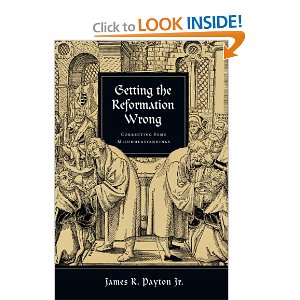
Click to Order
The first few chapters of this book deals with the cultural situation leading up to the break through by Martin Luther, which officially began the Reformation (although admittedly, others such as Zwingli, had begun to preach about faith before Luther’s inquisitive announcement on the church door). He notes the famines, plagues, and other physical anxieties which besought the Europeans. Further, he writes about the rise of scholasticism, the humanism of the day and does well to separate the myth that the humanists of today and the humanists such as Erasmus, Luther and Calvin were in any way the same. He points to the war and revolts of the age, which brought death and destruction with no discernible outcome. Finally, there were two crises which struck me as important today.
The first was the Church leadership issue. From the Avignon Papacy to the rise of councils which actually sought to curb the power of the Pope, the Western Church was attempting renewal, at least from within, of its governing institutions. It failed, as we now know. Monastic societies, and saints of the ages, railed against the abuses of power by the Church. Of course, secular authorities took advantage of it, trying to use the divisions to their gain. Arriving on the scene were the mystics and the preachers of repentance. The latter group urged a change of living to appease the wrath of God, turning instead of their common existence to the ‘penitential practices common among monks and nuns.’ (p50)
The final crisis, although not defined as such by Payton, was the fact that Europe was not hegemonic, with simmering hate towards Rome, although generally the Rome of its Imperial Past. These individual groups, such as the Germans and the English – those who were conquered by Rome, but never fully assimilated into the myth – were looking for a chance to overthrow the rule by the Roman papacy over their national churches.
____
Sitting in Church Renewal Class with Dr. Jason E. Vickers, he was making the case that in times of high anxiety, Renewal and Reformation seems to be stressed. The Reformation of Luther, Calvin, and Zwingli was not the first such move in Christianity, as I would assuredly count that the great Councils and synods of the 4th century was a result, in large part, of levels of anxiety. But, for today, are we not seeing some of the same crises which gripped Europe during the age preceding the Reformation? We have church leadership issues from everything including molestation to the prosperity gospel to everyone person made a biblical interpreter. Wars? Revolts? We have them in abundance. While there is no Cold War, there is the fear that we may be the target of a new terrorist attack at any moment, and not to be fooled, it is in large part directed towards Christian countries. Plagues? Every type of animalistic flu you could think of, not to mention cloning and others areas of medical health concerns. We have the rise of new monastic communities as well as the legalists. Further, we have historical critical biblical studies which many believe undermines historical, creedal, Christian theology.We have scholastics, however, such as John Piper and Albert Mohler, Jason E. Vickers, N.T. Wright, and others who are writing, academically, to the lay Christian audience just as much as they are writing to the minds in Athens. There is also the cry of Ad Fontes!, or, to the sources for our theology and moral guidance.
So, is it time for another Reformation?
Related articles
- In Honor of Calvinists, New and Old (challies.com)
- The Political Impact of Calvin’s Institutes of The Christian Religion (socyberty.com)
- The Protestant Reformation: A Study Guide (brighthub.com)
- A Thousand Miles in the Footsteps of Martin Luther (online.wsj.com)
Vincent of Lerins – Why the Church decides the Interpretation of Scripture
Posted by Joel in Vincent of Lerins on March 3, 2010
I was first made familiar of Vincent of Lerins through the use of the Orthodox Study Bible, finding him to be no less abrasive today that he was 1600 years ago.Perhaps that is one of the reasons he is rarely used today – he focused on orthodoxy. In reading though my old thoughts on the subject, I have found myself attempting to measure up to his abrasiveness.
The quote that the editors use is this:
I cannot sufficiently wonder at the madness of certain men, at the impiety of their blinded understanding, at their lust of error, such that, not content with the rule of faith delivers once for all, and received from the times of old, they are very day seeking one novelty after another, and are constantly longing to add, change, and take away, in religion.
They use that to comment on the verse where Solomon tells us not to remove what that king termed the ancient landmark (Proverbs 22.28). The following is a selected passage from Lerins’ Commonitory. It is a good read for those who enjoy what might best be described as heavy metal doctrinal inerrancy.
[4.] I have often then inquired earnestly and attentively of very many men eminent for sanctity and learning, how and by what sure and so to speak universal rule I may be able to distinguish the truth of Catholic faith from the falsehood of heretical pravity; and I have always, and in almost every instance, received an answer to this effect: That whether I or any one else should wish to detect the frauds and avoid the snares of heretics as they rise, and to continue sound and complete in the Catholic faith, we must, the Lord helping, fortify our own belief in two ways; first, by the authority of the Divine Law, and then, by the Tradition of the Catholic Church.
While I might not completely believe in his outcome, Lerins is correct, that in order too prevent ‘heretical pravity’ from entering into the flock, we must first fortify ourselves with the Word of God, supremely, and then with the Tradition handed down through the Church. Of course, this Tradition must not be unchallenged, and should be examine biblically and historically. There is a good range of difference between the right doctrine and the allowance of a cultural, or communal, practice of a local congregation – I believe that Vincent is only talking about the former. The Tradition of interpretation is handed down, and measured by those and with those that stand immediately before us. Our approach may be different, our tools new, but the result should be the same, right? isn’t it always the Word of God that comes first, followed only then by Tradition?
[5.] But here some one perhaps will ask, Since the canon of Scripture is complete, and sufficient of itself for everything, and more than sufficient, what need is there to join with it the authority of the Church’s interpretation? For this reason,—because, owing to the depth of Holy Scripture, all do not accept it in one and the same sense, but one understands its words in one way, another in another; so that it seems to be capable of as many interpretations as there are interpreters. For Novatian expounds it one way, Sabellius another, Donatus another, Arius, Eunomius, Macedonius, another, Photinus, Apollinaris, Priscillian, another, Iovinian, Pelagius, Celestius, another, lastly, Nestorius another. Therefore, it is very necessary, on account of so great intricacies of such various error, that the rule for the right understanding of the prophets and apostles should be framed in accordance with the standard of Ecclesiastical and Catholic interpretation.
I wonder if Vincent doesn’t anticipate a common habit Protestantism, one in which everyone is allowed to interpret Scripture based only on his or her subjective reasonings. This has given the world many denominations, sects, splits and cults, as well as produced a fair number of atheists who cannot reconcile the Bible and the ‘inconsistencies’ found therein not because of the biblical texts, but because of their own traditional interpretation. This is why, starting with the very Word of God, the Church must have an interpretation that is universal, but mindful of human failure, on the points of Doctrine. I find myself in agreement with Vincent, that due to the great heresies that have arisen because of people failing to understand the depth of the Word of God, the very Word of God must be framed in interpretation by the Church who foundation is the Apostles and Prophets, with Jesus Christ being the chief cornerstone. It matters then to what Church is that true Church, doesn’t it?
[64.] Here, possibly, some one may ask, Do heretics also appeal to Scripture? They do indeed, and with a vengeance; for you may see them scamper through every single book of Holy Scripture,—through the books of Moses, the books of Kings, the Psalms, the Epistles, the Gospels, the Prophets. Whether among their own people, or among strangers, in private or in public, in speaking or in writing, at convivial meetings, or in the streets, hardly ever do they bring forward anything of their own which they do not endeavour to shelter under words of Scripture. Read the works of Paul of Samosata, of Priscillian, of Eunomius, of Jovinian, and the rest of those pests, and you will see an infinite heap of instances, hardly a single page, which does not bristle with plausible quotations from the New Testament or the Old.
Vincent faced the same problem then that many face today – too many people quote from something that they do not understand, often times in their own unique cultural context acting in a way which seems like the bible had been written by their neighbor, in order to persuade one or another to a different position, as if by the mere power of quotation (or memorization) an argument can be settled. Sometimes this is an accident of their tradition, but many times, this is purposed. Many will point to this Jesus of Nazareth as the Christ, but only to supplant the true and holy Faith with a false doctrine. They will use the books of the bible, as many has shown themselves capable of doing, and use great swelling words to convince their listeners that they are the leaders of the right way. This is not a new phenomenon, and nor should we expect to stamp it out. While Vincent was railing against those who do such things, we in the West known uphold Religious Pluralism.
[65.] But the more secretly they conceal themselves under shelter of the Divine Law, so much the more are they to be feared and guarded against. For they know that the evil stench of their doctrine will hardly find acceptance with any one if it be exhaled pure and simple. They sprinkle it over, therefore, with the perfume of heavenly language, in order that one who would be ready to despise human error, may hesitate to condemn divine words. They do, in fact, what nurses do when they would prepare some bitter draught for children; they smear the edge of the cup all round with honey, that the unsuspecting child, having first tasted the sweet, may have no fear of the bitter. So too do these act, who disguise poisonous herbs and noxious juices under the names of medicines, so that no one almost, when he reads the label, suspects the poison. (Vincent of Lérins, The Commonitory)
There is little to add to Vincent, as his colorful language and exact imagery of false prophets detail what is going on in the world today. These false prophets soothe the ears of the listeners with promises of miracles or prosperity, drawing the attention away from God. They have forsaken the doctrine, if they ever knew of it in the first place, to dwell among those that would edify their own destructive measures. They use the language of the heavenly Word as medicine, infusing it with poison all the while beguiling those whose heart seek God. They lead these people away, and it is owed to the fact that too many times people are told that ‘to each his own’ when it comes to biblical interpretation.
Stand and measure yourself against the Old, as there is nothing ‘new’. The Faith of the Church is the faith once and for all delivered. There is no ‘new’ word, no ‘now’ word. There is but the very Word of God.
I have to wonder how Vincent would have fared in today’s Christianity. Where would he have stood in biblical studies, textual and the various other criticisms, the numerous hermeneutics, interpretations, and the advent of modern technology which has diluted the authority of ‘the Church’ over ‘Christendom.’
Canon and the Council of Trent
Posted by Joel in Deuterocanon on November 9, 2009
One of the most enduring Protestant Myths is that in 1546, at the Council of Trent added to the Sacred Canon the books which are commonly termed the Apocrypha, or more recently, the Deuterocanon. In fact, contrary to this myth, what the Council did was to affirm what had been the Traditional Canon since the early Church.
Why is it that Rome always get the short end of the stick with the Hitler thing?
Posted by Joel in Religion and Politics on October 31, 2009
At Defending. Contending. they have taken this Reformation Day to point out the evils of Rome. Here are some which are just delightful:
My Attack on Protestantism
Not really, but I have come to the conclusion that one of the reasons we see a fall in the numbers of Evangelical Protestants and the rise of the East and Rome, is that people want something more than a ‘sinner’s prayer’ and a hand shake from the pastor. They want something to hold on to, to grasp, and to be a part of.


